






Details
Overview
Join me for the ultimate Newfoundland photography adventure! Over 12 days and 11 nights we'll work our way across the island during peak iceberg season, photographing icebergs, dramatic coastal landscapes, lighthouses, red fishing stages, and weathered outport villages — then finish with some of the best seabird photography in North America: puffins at Elliston, the massive gannet and murre colony at Cape St. Mary's, and humpback whales feeding and breaching with diving gannets from a long pebble beach.
Why tour Newfoundland with me? I've been going to Newfoundland for over 10 years and know the best spots for icebergs, birds, and amazing landscapes, and the best places to get snow crab or fish & chips!
Obviously I can't guarantee there will be icebergs, but June is usually peak iceberg season. However it is the winds and pack ice that decide where the icebergs end up!
I also can't guarantee whale sightings or diving gannets, that depends on whether the fish (capelin) they feed on are near the beach, but this trip is timed when that will hopefully happen.
Bring camera gear for everything from super wide angle to long telephoto lenses, and clothing appropriate for weather from freezing to 80F.
Tuition is $5990 and covers photography instruction and guiding — it does not include meals, lodging, or transportation.
What We'll Photograph
June is peak iceberg season in Newfoundland, and the seabird colonies are in full swing. Here's what we'll focus on — click any photo to view it large.
Icebergs
Icebergs calve off glaciers in Greenland and take about two years to drift down Iceberg Alley to the northern coast of Newfoundland. When they arrive they often have stunning shapes of pinnacles, towers, and arches. Twillingate, Fogo Island, and Bonavista are all hot spots for viewing icebergs near land.
Twillingate
Rugged headlands, towering cliffs and sea stacks, coves, and fishing villages, plus prime iceberg viewing. We'll do some short hikes to amazing coastal views.
Fogo Island
Iconic red fishing stages, weathered outport villages, and icebergs. Fogo Island requires a 30-45 minute ride on a drive-on ferry.
Bonavista — Puffins
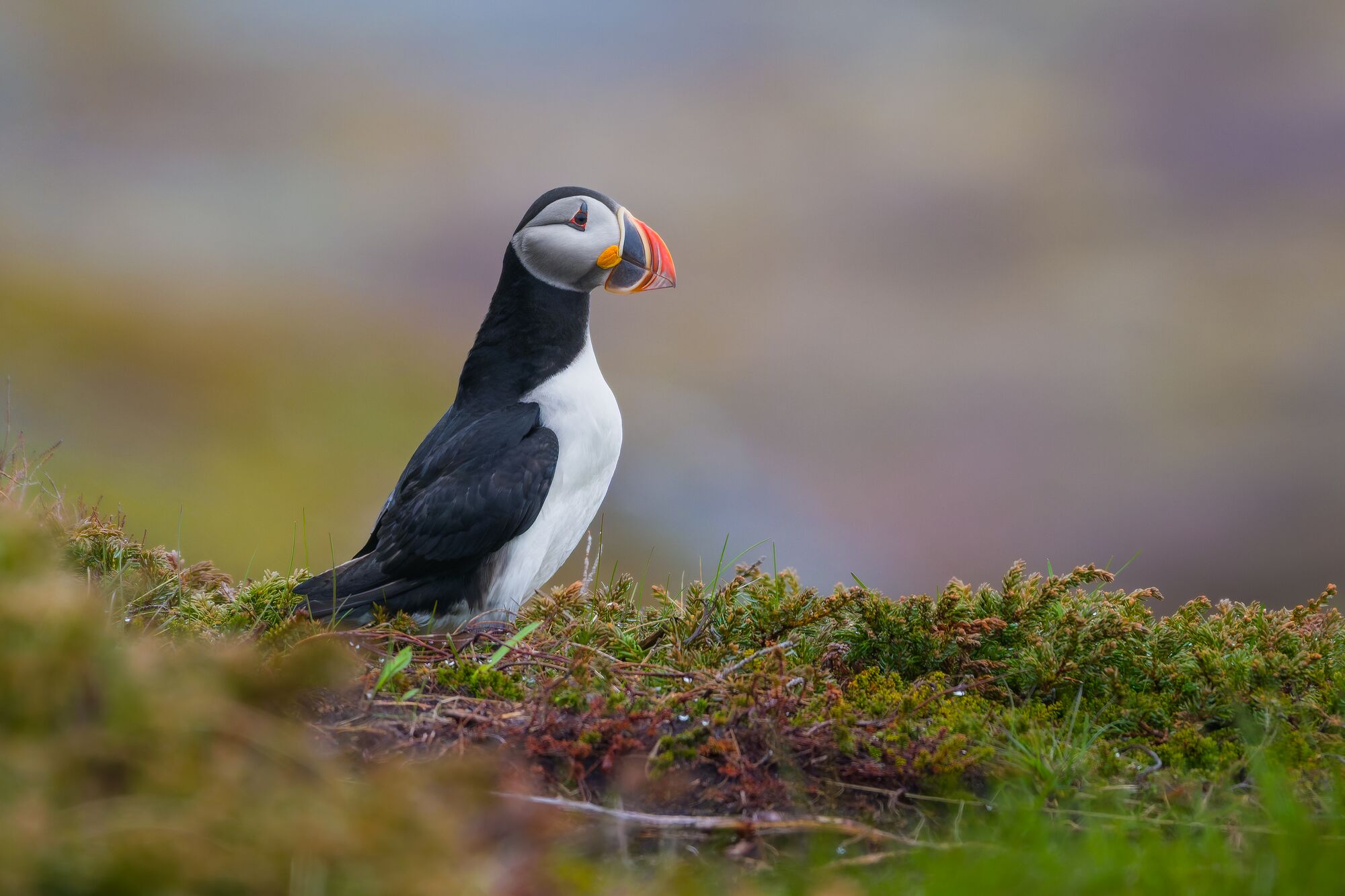
Puffins, icebergs, lighthouse, dramatic ocean cliffs and sea stacks. The highlight is the large puffin colony at Elliston, where a short hike brings you to a viewing area just 100 feet from their nesting island — and the puffins frequently land on the viewing area itself, allowing close up shots. No boat required! We'll also visit the stunning Cape Bonavista Lighthouse, and make a short hike out to some stunning sea stacks.
Southern Avalon — Whales & Diving Gannets
We'll visit an amazing cobblestone/pebble beach where the drop off into the ocean is so sudden that you can watch humpback whales feeding right in front of you, sometimes just 100 feet away, while northern gannets dive-bomb the water around them — all photographed from the beach, no boat required. This spot requires a lot of walking along the very large pebble beach, we may need to walk a couple miles as we follow the whales. Plus landscapes and lighthouses along the southern Avalon Peninsula.
Cape St. Mary's — Seabird Colony
Cape St. Mary's Ecological Reserve is one of North America's most accessible seabird colonies. It is home to tens of thousands of seabirds, including Northern gannets, black-legged kittiwakes, common murres, thick-billed murres, razorbills, black guillemots, cormorants, and Northern fulmars, nesting on sea stacks just a few yards from the viewing spot. An easy hike of 0.9 miles each way is required to reach the colony.
Schedule
- Twillingate — 4pm meet & greet (location TBD), dinner
- Evening & sunset photography
- Twillingate area photography — icebergs, cliffs, and fishing villages
- Sunrise and sunset shoots, with daytime exploring and location scouting
- Sunrise photos, drive to Farewell (1 hour), ferry to Fogo Island (30-45 mins)
- Sunset photos on Fogo Island — icebergs and iconic red fishing stages
- Fogo Island photography — icebergs and iconic red fishing stages
- Morning photos, ferry back to Farewell, drive to Bonavista (about 4 hours)
- Evening photography: Puffins, icebergs, cliffs, lighthouse
- Bonavista area photography — puffins at Elliston, the Bonavista lighthouse, icebergs, sea stacks
- Sunrise photos, drive to lodging in the Southern Avalon Peninsula (about 4 hours)
- Evening whale & diving gannet photography from the beach
- Whales & diving gannets from the beach
- Landscapes and lighthouses along the southern Avalon
- Drive to lodging for Cape St. Mary's (about 2 hours)
- Cape St. Mary's Ecological Reserve — northern gannets, common murres, and other seabirds
- Cape St. Mary's Ecological Reserve — northern gannets, common murres, and other seabirds
- We will also photograph giant sea cliffs, headlands, and other landscapes.
- Sunrise shoot, workshop ends
Included
- ✓ Photography instruction
- ✓ Guiding to locations
- ✓ Possible editing sessions (depends on schedule)
- ✓ Lots of fun!
Not Included
- ✕ Lodging
- ✕ Transportation
- ✕ Meals
- ✕ Camera gear
Physical Difficulty
Moderate hiking on rugged coastal trails with steep sections, hills, and loose rock beaches.
We may do a bit of hiking during some days, possibly 2-3 miles round trip depending on the schedule. This is on rugged coastal trails with exposed roots, rocks, and small hills. Other days there will be little or no hiking.
Please advise me of any mobility issues.
Getting There
You might want to consider driving to Newfoundland, it will allow you to bring all your camera gear. You will take the ferry from North Sydney, Nova Scotia and arrive in Port-aux-Basques, Newfoundland. Marine Atlantic is the ferry operator. The ferry ride is about 6.5 or so hours depending on conditions. You need to arrive at the ferry terminal 2 hours prior to departure. The ferry sells out so I recommend booking soon, especially if you want a cabin.
Major airports in Newfoundland, with driving times to Twillingate where the workshop starts:
- Gander (YQX) — 90 minute drive
- St. John's (YYT) — 5 hour drive
- Deer Lake (YDF) — 4 hour drive
The workshop ends at Cape St. Mary's on the Avalon Peninsula, about a 2.5 hour drive from St. John's (YYT).
You will want to book your rental car ASAP, they sell out during iceberg season.
Lodging
Lodging is not included — you pay for your own lodging at every location.
I have blocks of rooms booked for the 2 nights near the whale watching beach along the Southern Avalon Peninsula, and the 2 nights at Cape St. Mary's, so those stays are easy, just pay for your room when checking-in. Details provided upon booking your workshop. I had to reserve these ahead of time because there is very little lodging available in those areas.
For all other locations you will need to find and book your own lodging, but I'm happy to help you find a place.
There are inns and B&Bs, and there are a lot of small cottages on Airbnb for very reasonable rates. Many of these are on the water or have water views and have been recently renovated. Personally, a small "all to yourself" cottage/cabin through Airbnb/VRBO would be my preference.
Newfoundland is a great place for RVs with lots of free boondocking. I will be staying in my small RV, you can boondock with me if you have a small RV. If you have a large RV it would still work, but definitely check with me about that. This assumes you can boondock all night without shore power. Campgrounds are also available.
Here are recommended areas to look for lodging for the destinations you'll book yourself:
- Twillingate · 3 nights · check-in June 8, check-out June 11Book in Twillingate, Crow Head, or Durrell (all parts of Twillingate).
- Fogo Island · 2 nights · check-in June 11, check-out June 13Book in Joe Batt's Arm, Fogo, or Tilting, but anywhere on Fogo Island will work. There is only one hotel on Fogo Island and it is bonkers expensive, so you will need to look on Airbnb/VRBO.
- Bonavista · 2 nights · check-in June 13, check-out June 15Book in Bonavista, Elliston, or Maberly.
- Southern Avalon Peninsula · 2 nights · check-in June 15, check-out June 17Lodging is reserved for you in Trepassey at a motel ($189/night + tax), but feel free to book your own cottage in the area.
- Cape St. Mary's · 2 nights · check-in June 17, check-out June 19Lodging is reserved for you in St. Bride's at an inn ($169/night + tax), but feel free to book your own cottage in the area.
Let me know if you need help!
Important to Know
Tuition
Tuition is $5990 per person. A $500 non-refundable deposit is required to book your spot, and the balance of $5490 is due January 15, 2027.
Tuition covers photography instruction and guiding only. Meals, lodging, and transportation (including ferries and rental cars) are your responsibility and are not included.
Cancellation Policy & FAQ
Registration
Please fill out the form below to request your spot in the workshop. I'll check your equipment list to see if it will work for the workshop and I'll e-mail you back with information on how to pay the tuition online.
You must be 18 years of age or older. By filling out this form you acknowledge that you understand the weather and cancellation policies.